Easy, Personalised, Intuitive, Contextual
EPIC means Easy, Personalised, Intuitive and Contextual Customer Service Experience. It defines how a customer, a guest or a whole group should be treated: they use their own words, they are known from the first contact, the likely next need is anticipated, and everything that matters travels with them to the right owner.
The conventional model makes continuity the customer’s job. They fit a form or a menu, verify the same details every time, explain the situation again after each handoff, and the person who finally answers has none of the context that mattered.
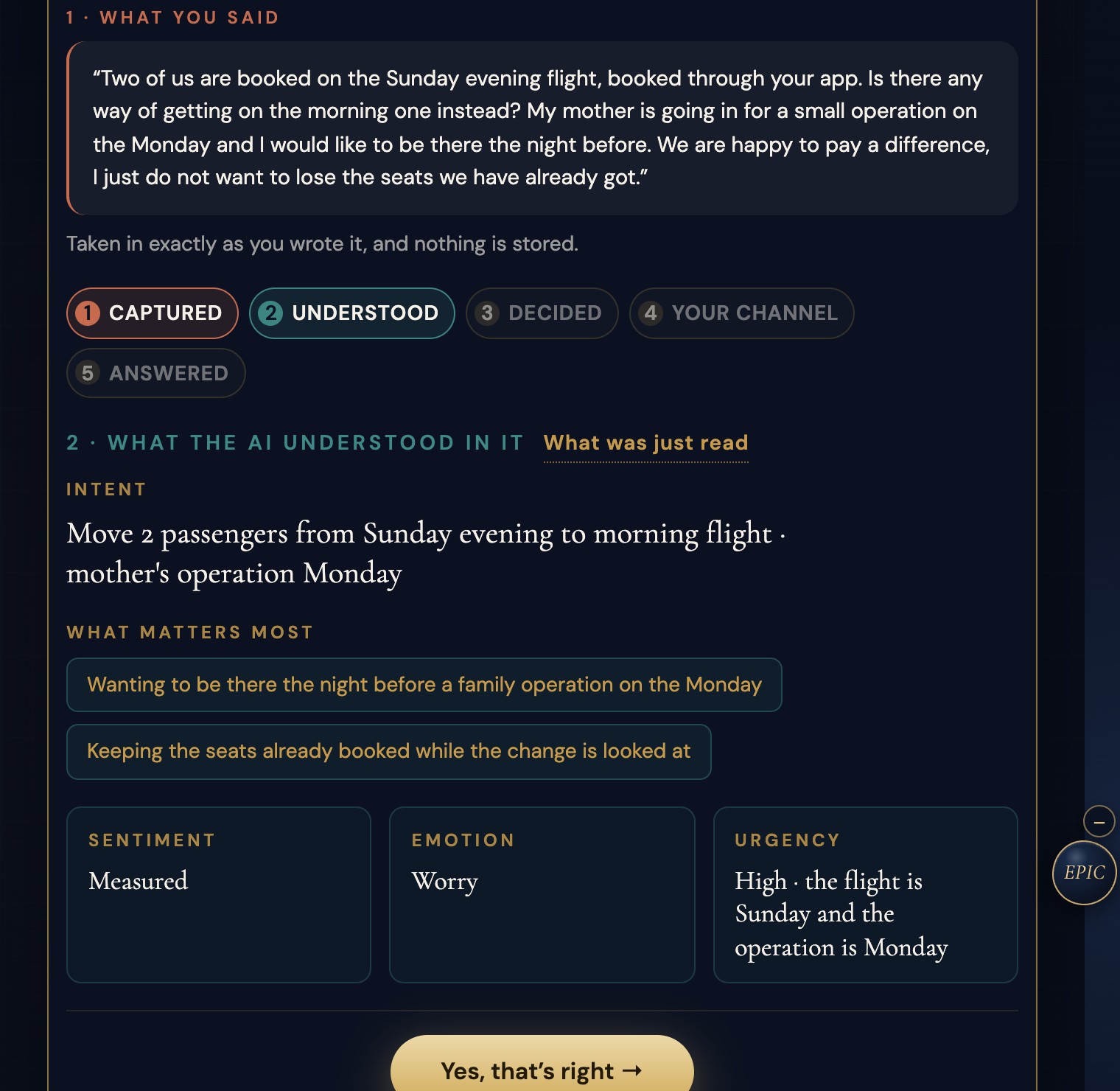
Easy: the customer says it once, in any words, on any channel, and is never asked twice. Personalised: the response uses the relationship, the circumstances and the commercial context, not a segment label. Intuitive: the brand anticipates the next need and removes the effort before it is asked for. Contextual: intent, emotion, urgency, history, risk, group dynamics and opportunity arrive together with the named owner.
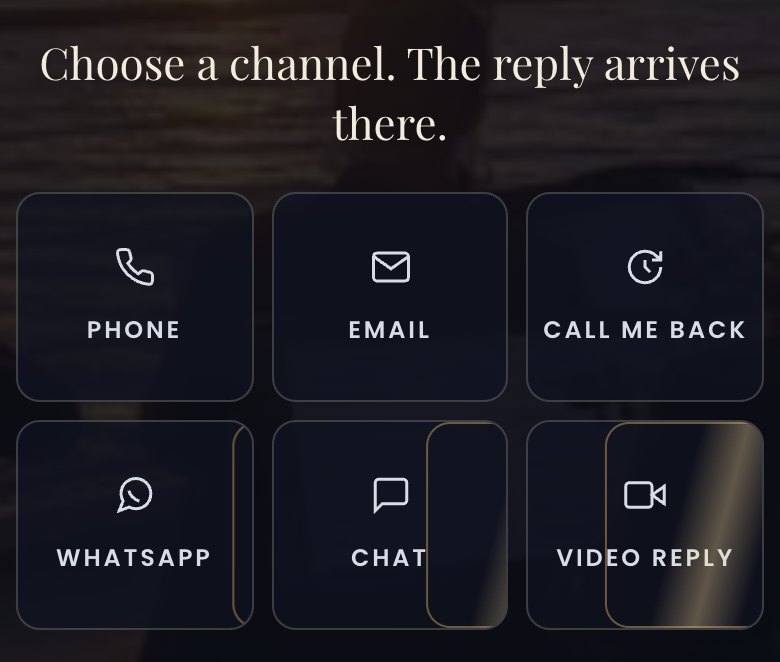
In the Cruise experience one guest writes for eight: her parents’ wedding anniversary, a Mediterranean sailing, a private dinner on the first night. Twenty-nine words, read once. The build reads the intent, what matters most (a dinner arranged by a person, the staterooms kept close), the warmth and anticipation behind the words, and the urgency of a celebration to arrange. She chooses WhatsApp, and the reply arrives there in the name of James Harrington, the Ambassador the read routed her to, carrying the eight travellers, the anniversary and the dinner without asking for any of it again.
Working demonstration. The ship, the line and the people are illustrative.- AI
- Reads the words once for intent, what matters most, sentiment, emotion and urgency, assembles the group context and carries it to the channel the customer chose.
- Rules
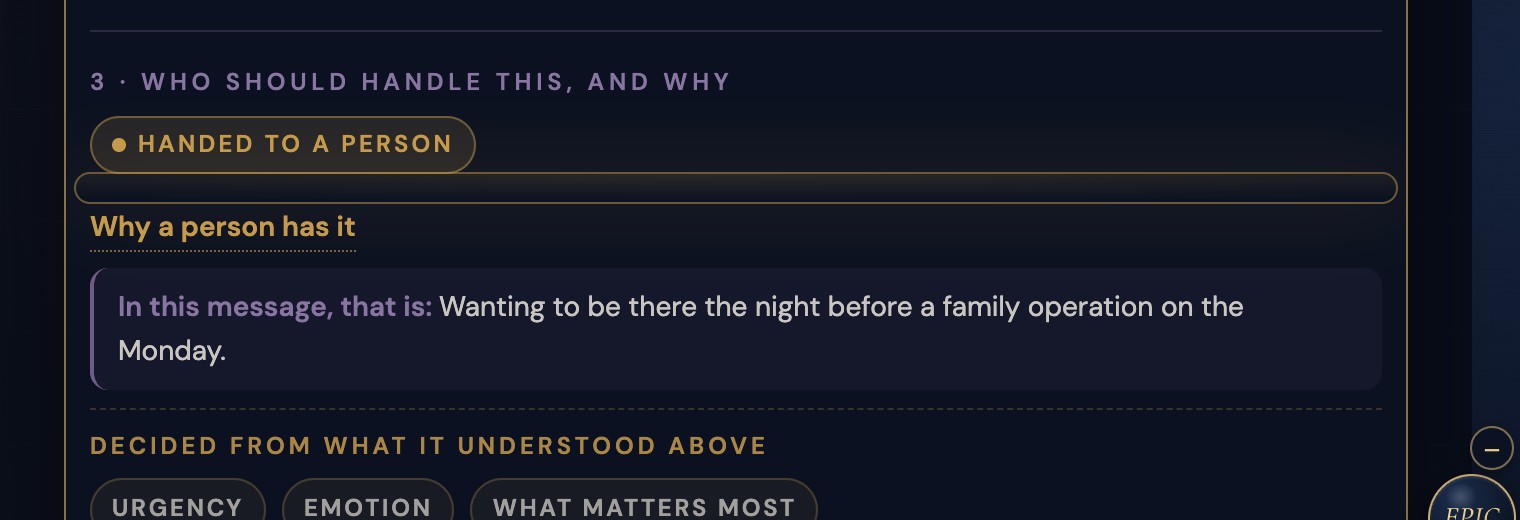
- Decide what can be answered straight away and what must reach a person: an occasion for eight with a dinner to arrange routes to an Ambassador who specialises in occasions.
- People
- The named Ambassador owns the relationship, the judgement about the dinner and the staterooms, and every conversation from then on.
They are understood on the first attempt, treated as the person and the group they are, and never made to carry the brand’s context for it.
The person who answers starts informed, with the words, the history and the signals on one screen, so their time goes on judgement rather than reconstruction.
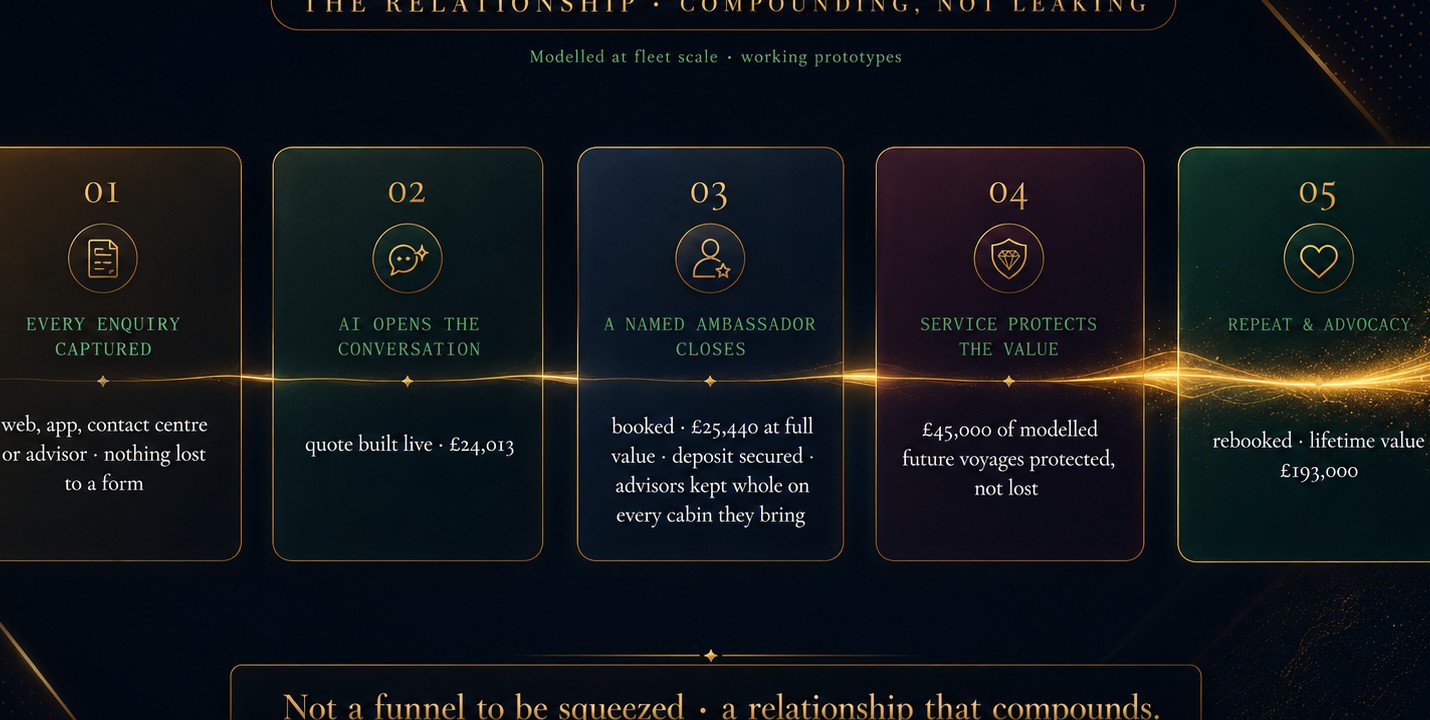
Less friction and fewer repeat contacts, earlier and better prioritisation, more enquiries progressed and a relationship that compounds instead of resetting.
I start every operation with the customer’s own words. If a customer has to learn our menu, verify twice and tell the story again after a handoff, the design is wrong, and I hold the design to account before I hold the people to it.
Time, Information, Motivation, Empowerment
TIME EX means Time, Information, Motivation and Empowerment. It gives the colleague handling the relationship the time, information, motivation and empowerment needed to deliver the right outcome. Customers feel served when the person in front of them can serve.
The conventional model gives the colleague a stopwatch, a script, a search box and a queue. Administration eats the time, the context arrives late or not at all, the authority sits with a manager, and quality is sampled a month later.
Time: administration, duplicate entry and avoidable follow-up are removed so attention goes on the customer. Information: the words, history, intent, emotion, urgency, commitments, risks and opportunities are together before the colleague acts. Motivation: the work connects to a visible outcome, recognition and coaching on the live moment. Empowerment: the named owner has the authority, the guardrails, the next best action and the tools to resolve it without bouncing it elsewhere.
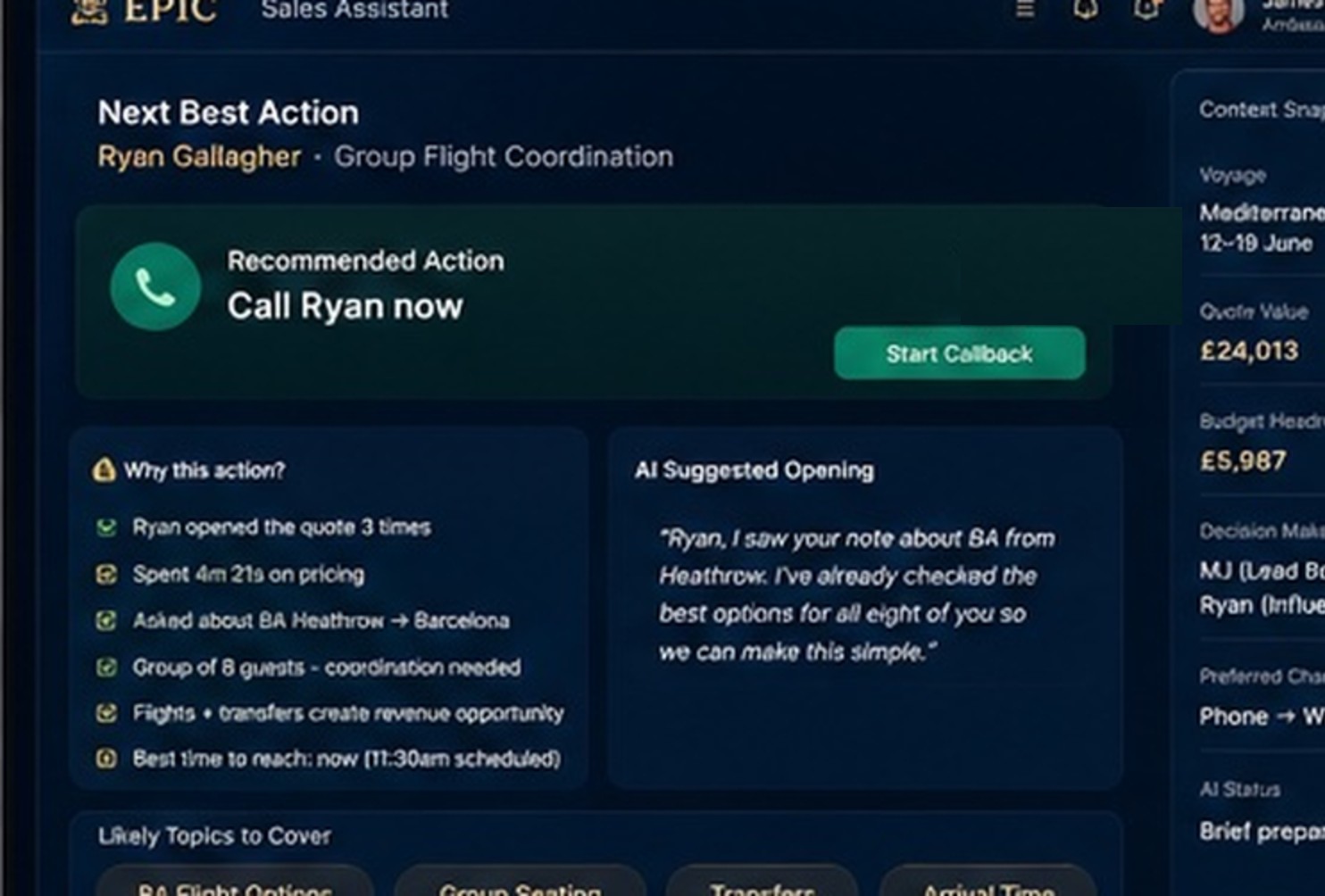
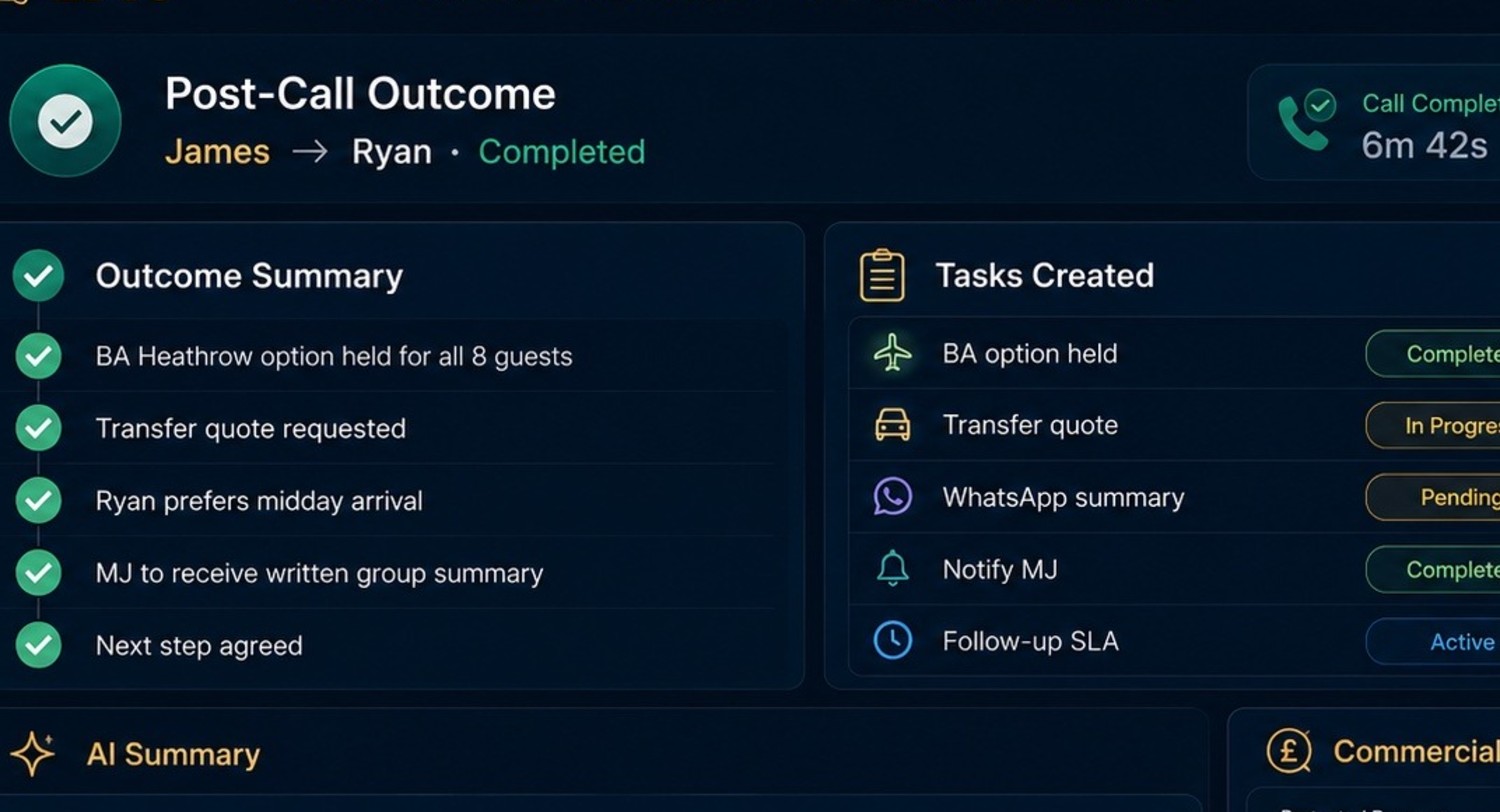
The same anniversary group, a little later. James Harrington is about to call Ryan, one of the eight, about the group’s flights. Before he dials, the brief is in front of him: Ryan has opened the quote three times and asked about flying from Heathrow, eight people need coordinating, and there is a suggested opening in James’s own voice. He decides whether to use a word of it. When the call ends, the board shows the outcome captured once: summary, tasks, follow-up, and the CRM, timeline and quote notes updated from that single record.
Operating boards with illustrative data on a real operating structure. James, Ryan and the group are illustrative.- AI
- Assembles the brief, explains why this action now, drafts an opening the colleague is free to ignore, and writes the summary and the tasks when the conversation ends.
- Rules
- Set the authority and the guardrails: what the colleague may resolve on the spot, what must reach a specialist, and what has to be recorded. In Banking, a vulnerability signal routes to a specialist under a live-connect rule.
- People
- The named colleague makes the judgement, has the conversation and owns the outcome. The leader coaches on the evidence of the live moment, not on a sample a month later.
They meet a prepared human with the authority to act, who already knows the situation and does not have to leave to ask.
Administration falls away, the context is there before the conversation starts, the next step is suggested rather than scripted, and the record updates itself.
Better quality and consistency, higher productivity, stronger engagement and retention of good people, and a lower cost of getting things wrong.
Whatever the size of the team, the rule has never changed: give people the time, the information and the authority, then hold them to the outcome, not to the script. Administration is the first thing I take off their desks, and coaching on a live moment is the first thing I put back.
The supercharger
Orchestration is the intelligence and coordination layer above every channel. It reads what the customer said, decides whether AI can complete the next step or a person is needed, chooses the right person, skill, team and channel, keeps one memory across six or more channels, guides the colleague without scripting away judgement, and writes the summary, the tasks and the workflow updates afterwards.
The conventional answer is a chatbot in a window, measured on containment. It answers inside its own channel, ends when the window closes, and hands a colder customer to a person who starts from nothing.
One operating sequence runs everywhere: signal, interpretation, orchestration, human ownership, action, then learning and the commercial outcome. Every step is visible and every decision can be traced. The differentiator is not autonomy; it is intelligent coordination of the whole brand around the right outcome.
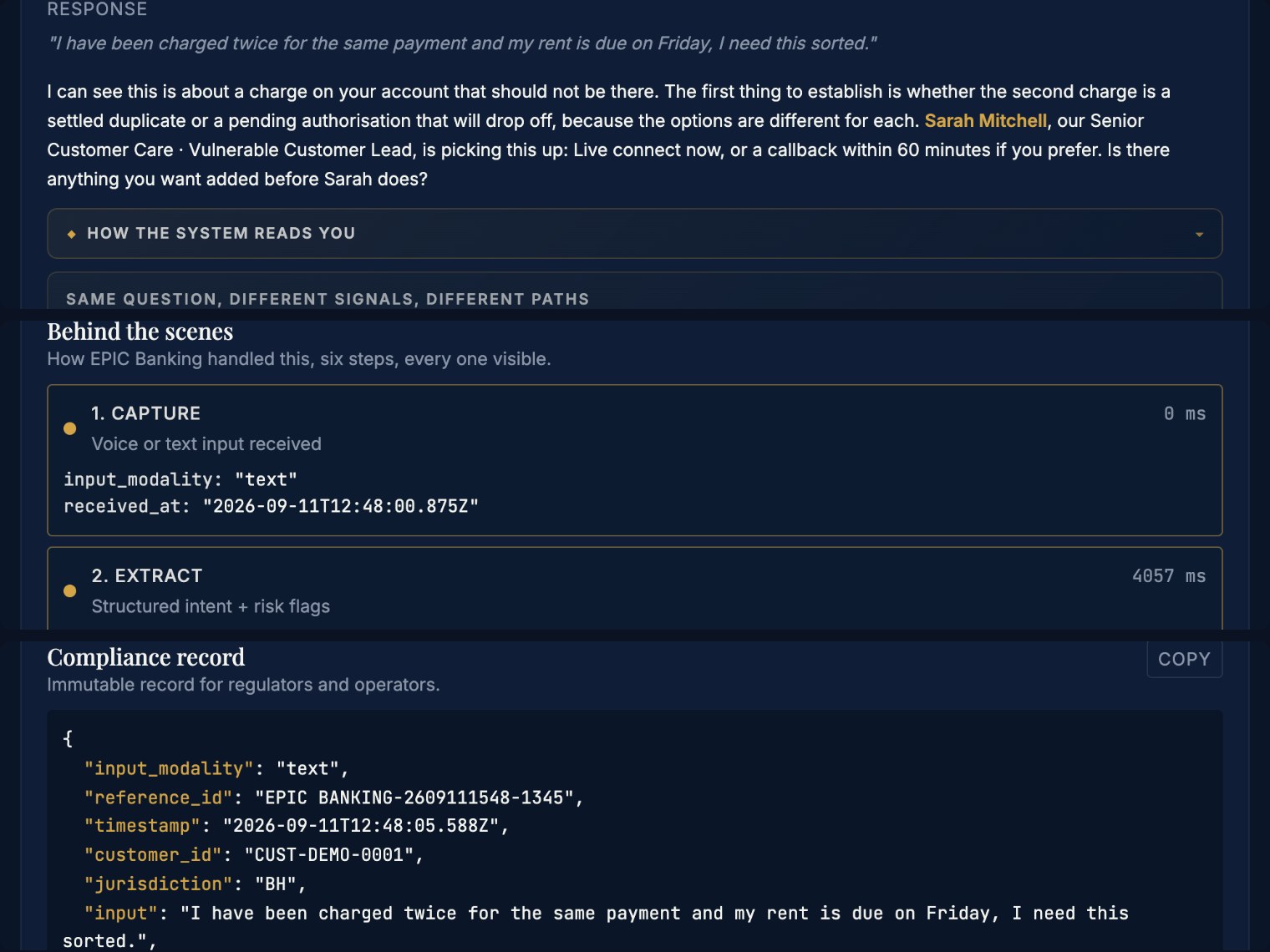
In the Digital Banking demonstration a customer writes: “I have been charged twice for the same payment and my rent is due on Friday, I need this sorted.” The model reads the money, the deadline and the strain together, and decides this is not a job for a chatbot. The reply names Sarah Mitchell as the specialist and offers a live connection now or a callback within the hour; the choice stays with the customer. Underneath, six steps are visible and a compliance record is written, so the decision can be audited afterwards.
Working demonstration. The bank, the customer and the specialist are illustrative; nothing is charged or refunded.- AI
- Reads the message, scores intent, urgency and risk, chooses between completing the step itself and bringing in a person, briefs that person and writes the trace.
- Rules
- The regulated guardrails: a money-at-risk or vulnerability signal must reach a qualified person, on a live connection, with every step recorded for audit.
- People
- The specialist makes the decision, owns the outcome and can see why the model brought it to her. The leader can trace every decision afterwards.
The right person or the right automation acts first time, on the channel they chose, with nothing lost between steps.
People are brought in when judgement is needed, already briefed, and are not asked to do the coordination themselves.
Faster resolution, fewer transfers and repeats, auditable decisions, and capacity released to the moments that need a person.
I do not measure AI on containment. I measure it on whether the right person or the right automation acted first time, and whether I can trace why. If I cannot explain a decision to a customer or a regulator, it does not go live.
Live trust intelligence
Brand Sentiment is Alex’s live measure of how a relationship is moving. It reads tone, language, browsing, behaviour and real relationship events to show trust, frustration, hesitation, anxiety, delight and recovery while intervention is still possible.
A survey score asks a voluntary question after the event. It is slow, selective and easily distorted, and by the time a complaint arrives the guest has already decided not to come back.
The signal moves because of an actual event, the evidence that moved it is visible, a threshold or rule triggers a named action, a person owns that action, and the board shows whether trust recovered. Emotion is connected to service and to commercial action, not filed as a score.
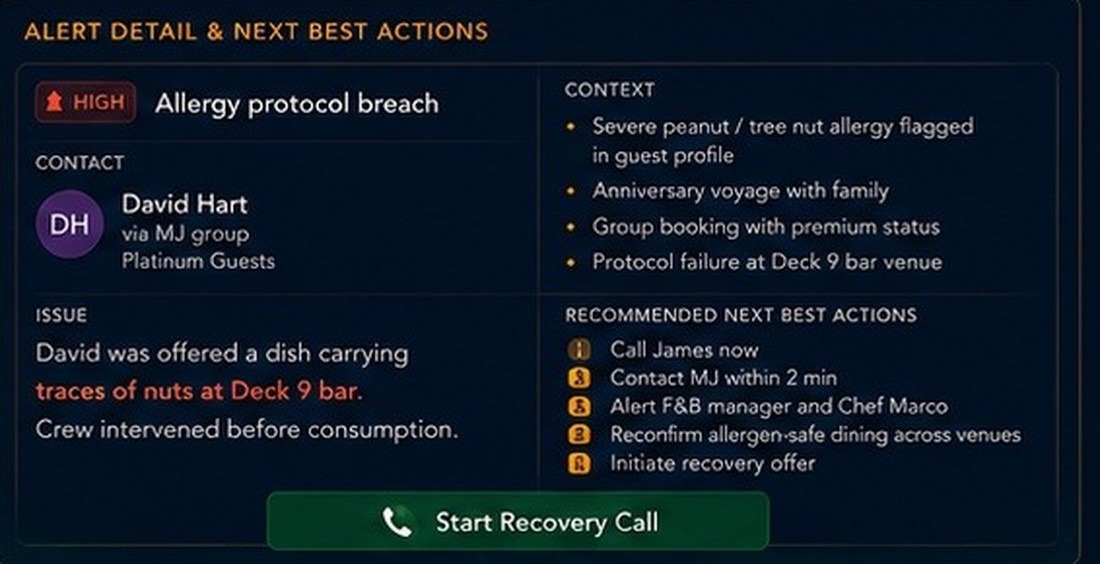
In the Cruise walkthrough, an illustrative scenario, a snack carrying nut traces is offered to David at a pool bar and stopped before it reaches him. Nothing is eaten. What has broken is a service promise: the restaurants had the protocol, the bars had not. The system detects it without a formal complaint. David receives an immediate, specific, truthful acknowledgement. AI gathers the evidence and lines up the actions. James Harrington, a named person, owns the judgement, the communication and the relationship. The illustrative arc shows trust falling and recovering while action still matters, from 8.5 to 3.2, back to 9.2 inside twenty-two minutes and 9.4 by the end of the voyage, and the operating rule is corrected across every food and beverage location.
Illustrative scenario and illustrative arc. The guest, the ship and the people are not real.- AI
- Reads tone, language, behaviour and relationship events through the voyage, moves the signal, shows the evidence that moved it and assembles the actions.
- Rules
- A threshold escalates to a named owner inside ninety seconds (illustrative timing), and a dietary signal at any venue reaches the person who holds the protocol.
- People
- James owns the judgement and the conversation. The leader sees whether trust recovered and corrects the operating rule for every bar and restaurant.
The brand notices and acts during the journey, instead of apologising afterwards.
A named person is triggered with the evidence and the authority to recover the moment, not a survey result three weeks later.
Retention and advocacy instead of silent churn, risk caught early, and emotion connected to service and commercial action.
A survey tells me what a guest thought three weeks ago. I want to know what they feel now, with the evidence, while I can still do something about it. Then I ask the harder question: not whether the guest was placated, but whether the operating rule has changed so it cannot happen again.
Before, during and after
Operational control is the leadership loop that turns every interaction into action, learning, capacity decisions, risk control and commercial opportunity. It is what makes the customer promise deliverable with 4,000+ people as well as with 50.
Most operations run blind between the moments that matter: quality sampled, channels managed separately, escalations discovered after the fact, forecasts that do not know what customers are about to do.
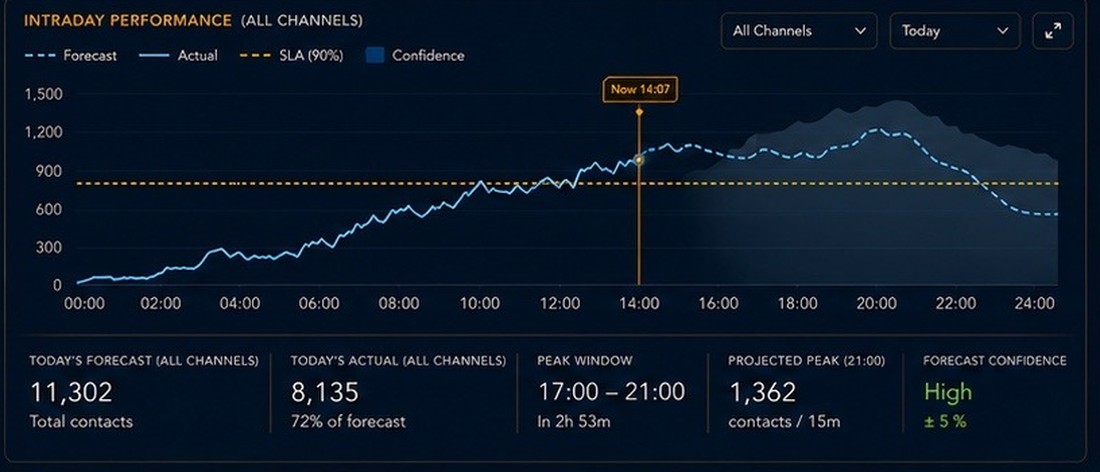
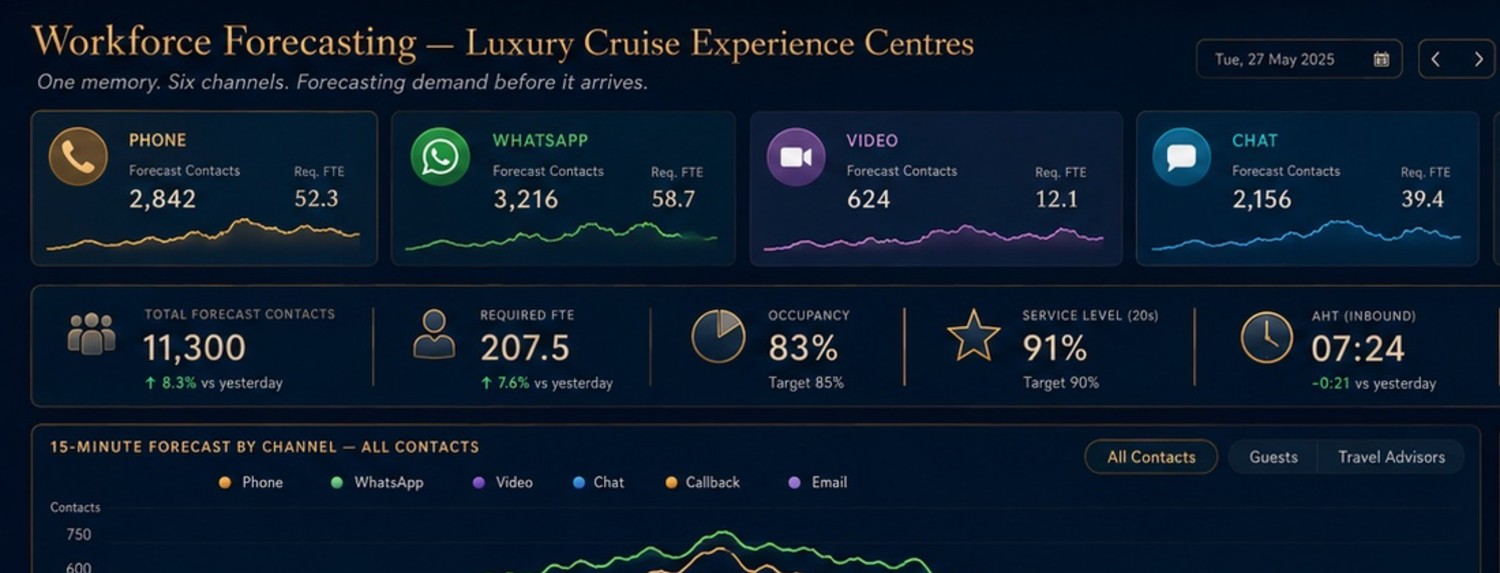
One operating rhythm: demand forecast by channel, people scheduled to the skills the demand needs, six channels read as one, service level, backlog and risk on one board, incidents owned with a next action, quality scored on every interaction, and an executive view of quality, opportunity and repetition avoided.
In the Cruise demonstration a connection is missed at sea. The AI reads the alarm, James Harrington owns it until they are aboard, and the modelled arc ends the voyage higher than it began. An excursion running late on the Amalfi coast is read the same way: a signal during the day, not a complaint after it. Around each moment the same rhythm runs. Before: the forecast and the people on shift set by channel and skill. During: one board showing today against the forecast and the peak still to come. After: the interaction scored and the lesson owned.
Working demonstration and illustrative boards. The ship, the line and the people are illustrative; the arc is modelled.- AI
- Forecasts demand by channel in fifteen-minute intervals, reads live signals (a late excursion, a missed connection, a queue forming), scores quality on every interaction and drafts the next action.
- Rules
- Service levels, escalation thresholds and authority limits, set by the leader, decide what triggers whom and when.
- People
- Leaders steer channels and capacity, own incidents with a named next action, coach on the evidence and change the operating rule when the pattern says so.
Service stays responsive as conditions change, and the promise made at booking is kept on the day.
Leaders see, decide and act across the whole operation; teams are staffed to the demand and coached on evidence.
Lower cost, better control, less risk, revenue protected and grown, and an operation that improves from what actually happened.
Before, during and after: that is how I run a day. Before, the forecast and the people match what customers are about to do. During, one board, not six. After, every interaction scored and the lesson owned by a named person. I have run this with teams from 50 to 4,000+, and the rhythm does not change with the size.